Knife in Luggage at Istanbul Airport: Law 6136 Weapons Charge
A knife found in your bag at Istanbul Airport can open a criminal file under Law No. 6136. Which knives the Law covers, Articles 14 and 15, and your rights.
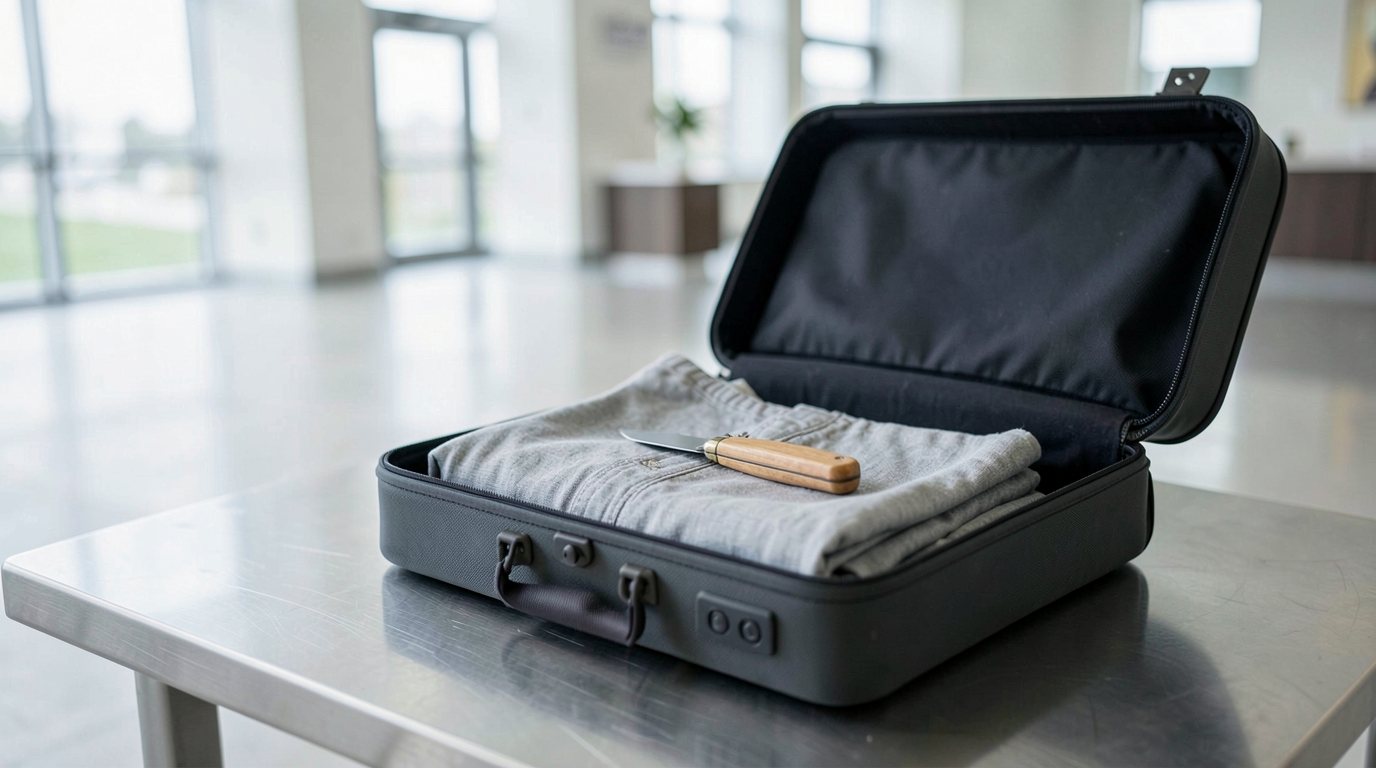
A traveller lifts a suitcase onto the screening belt at Istanbul Airport. On the monitor, a small shape appears among the folded clothes: a pocket knife bought as a souvenir, or a folding knife that has lived in the same bag for years and was forgotten. The bag is opened, the knife is taken out, and someone asks the traveller to wait. From that moment the question may no longer be about baggage rules but about Turkish criminal law.
This guide explains, on the text of the law, how Turkish law deals with a knife found in a traveller's luggage: which knives Law No. 6136 on Firearms, Knives and Other Tools covers and which it expressly leaves outside, the difference between carrying a knife and bringing one into the country, how the summary procedure in the Code of Criminal Procedure (CMK, Law No. 5271) fits in, and what rights a foreign traveller has if asked for a statement. It is general information, not advice on a particular case. The outcome of any real file depends on its facts and on the assessment of the prosecutor and, if a case is opened, of the court.
1. Two Different Sets of Rules: Baggage Security and Criminal Law
Two separate questions arise when a knife is found in a bag at an airport, and it helps to keep them apart from the start.
The first is a baggage and aviation security question: whether the item may travel in the cabin or in the hold at all. Airline and airport security rules on what passengers may carry are separate from the criminal law, and this guide does not describe their content. An item can be refused at screening without any criminal file being opened.
The second is a criminal law question: whether the knife itself, and what the traveller was doing with it, falls under an offence in Turkish law. That question is governed mainly by Law No. 6136 on Firearms, Knives and Other Tools (Ateşli Silahlar ve Bıçaklar ile Diğer Aletler Hakkında Kanun).
Article 1 of Law No. 6136 sets its scope. Bringing into the country, making, selling, buying, carrying or possessing firearms and their ammunition, and knives and other tools made specially to be used solely in attack and defence, is subject to the Law. The words "made specially" and "solely in attack and defence" matter: the Law does not treat every blade as a weapon in the same way.
Whether a particular knife falls within the Law, and which provision, if any, fits the facts, is not decided at the screening belt. It is a legal assessment made in the investigation by the chief public prosecutor's office and, if a case is opened, by the court.
2. Which Knives Law No. 6136 Covers
The core of the Law is Article 4, which has three relevant paragraphs.
Article 4(1) — the listed knives. Within the country, the making of the following is prohibited: kama, hançer (daggers), saldırma, swordsticks (şişli baston), switchblades (sustalı çakı), pala, swords (kılıç), kasatura, bayonets (süngü), pointed and grooved knives (sivri uçlu ve oluklu bıçaklar), maces (topuz), whips with a knob (topuzlu kamçı), garrotte wire or chain (boğma teli veya zinciri) and knuckle-dusters (muşta), together with similar tools of a special nature intended to be used solely in attack and defence.
Article 4(2) — permitted knives for a trade. Those of the listed items whose use is necessary for the exercise of a trade or profession may be made with permission, under rules set in a regulation issued by the Ministry of Interior.
Article 4(3) — knives outside the Law. The use of knives, skewers, scrapers and similar items that are household items, or tools used in medicine, industry, agriculture or sport, or that are necessary for the exercise of a trade or profession, is not subject to the provisions of the Law. The same paragraph also covers certain sporting firearms, which are outside the scope of this guide.
Article 5 then adds the rule that matters for travellers: selling, buying, carrying and possessing the knives and tools within Article 4(1), whose bringing into the country and making are prohibited, is prohibited. Knives permitted under Article 4 for the exercise of a trade or profession are outside this prohibition.
Article 2 of the Law also states that bringing into the country firearms and their ammunition, and knives and other crime tools made specially to be used solely in attack and defence, is prohibited, subject to the public-institution and diplomatic exceptions listed there.
Souvenir and antique knives. Article 11 provides that permission must be given for possessing firearms and knives that are souvenirs (hatıra) or antiques. The permission given for antique firearms and knives covers only leaving them with their owner or transporting them; it does not allow carrying them on the person.
The word "weapon" in the Penal Code. Article 6(1)(f) of the Turkish Penal Code (TCK, Law No. 5237) defines "weapon" for the application of criminal laws. The definition includes all kinds of cutting, piercing or bruising tools made to be used in attack and defence, and also other things that, although not made for attack and defence, are in fact suitable for use in attack and defence. This is a general definition in the Penal Code. Whether carrying a given knife is an offence is answered by the provisions of Law No. 6136 discussed below.
Which category a particular knife belongs to — a listed knife under Article 4(1), a household or trade knife under Article 4(3), or a souvenir or antique under Article 11 — depends on the item itself, and that is assessed by the prosecutor and the court.
3. Carrying a Knife (Article 15) and Bringing One Into the Country (Article 14)
Law No. 6136 contains two separate offence provisions that are relevant to a knife found in luggage. They are worded differently and carry different penalties.
Article 15 — selling, buying, carrying or possessing
Article 15(1). A person who, contrary to the provisions of the Law, sells, acts as an intermediary in selling, buys, carries or possesses the knives or other tools written in Article 4, or similar items, is punished with imprisonment of six months to one year and a judicial fine.
Article 15(2). If the knives or other tools within the article are grave in number or nature, the penalties under paragraph 1 are increased by from one half to one fold.
Article 15(3). A person who sells, buys, carries or possesses knives whose making is permitted under Article 4 (the trade knives), outside the purpose of their use, receives the penalty in paragraph 1, or in paragraph 2 where the number and nature are grave.
Article 15(4). A person who carries the knives and other tools written in Article 4(3) — that is, the household, medical, industrial, agricultural, sporting and trade knives that the Law otherwise leaves outside its scope — solely for the purpose of using them in an attack, according to the circumstances, is punished with imprisonment of up to three months or a judicial fine.
Read together, Article 4(3) and Article 15(4) say two things at once. A kitchen knife or a work knife is, as a rule, outside the Law. But carrying such a knife becomes an offence where, judged according to the circumstances, it was carried solely to use it in an attack. The purpose is part of the offence, and whether it existed is assessed on the facts by the prosecutor and the court.
Article 14 — bringing into the country
Article 14(1). A person who, contrary to the provisions of the Law, brings into the country, attempts to bring into the country or acts as an intermediary in bringing into the country the knives or other tools written in Article 4, or similar items, or makes them in the country, or transports or sends them from one place to another or acts as an intermediary in their transport, is punished with imprisonment of two to five years and a judicial fine. Where the knives and tools that are the subject of the offence are small in number, or by reason of their nature, the penalty is reduced by up to one half.
Article 14(4). If the knives and other tools within the article are grave in quantity, the penalties are increased by one half.
Article 14 carries a heavier penalty than Article 15(1), and it contains its own reduction for a small number of knives or for their nature. Whether a knife found in the bag of an arriving passenger is examined under Article 14, under Article 15, or under neither is a legal assessment made in the investigation and, if a case is opened, by the court. This guide does not go further than the text, and it does not predict how a given file will be classified.

4. Law No. 6136 Articles 4(3), 15 and 14 Side by Side
| Provision | Which knives | What the text punishes | Penalty in the text | In the CMK 250(1)(b) summary procedure list? |
|---|---|---|---|---|
| Art. 4(3) | Household knives and tools used in medicine, industry, agriculture or sport, and knives needed for a trade | Not subject to the Law | None under Art. 4(3) itself | Not applicable |
| Art. 15(1) | Knives listed in Art. 4 (switchblade, dagger, sword, bayonet, pointed and grooved knives and similar) | Selling, buying, carrying or possessing contrary to the Law | Six months to one year and a judicial fine; increased under Art. 15(2) where grave in number or nature | Yes |
| Art. 15(3) | Trade knives whose making is permitted under Art. 4 | Selling, buying, carrying or possessing outside the purpose of their use | The penalty in Art. 15(1), or Art. 15(2) where grave | Yes |
| Art. 15(4) | The knives in Art. 4(3) | Carrying solely to use them in an attack, according to the circumstances | Up to three months or a judicial fine | No |
| Art. 14(1) | Knives listed in Art. 4 | Bringing into the country or attempting to; making in the country; transporting or sending from one place to another | Two to five years and a judicial fine; reduced by up to one half where small in number or by reason of their nature | No |
The table sets out the text only. Which provision, if any, applies to a knife found in a bag is assessed on the facts by the prosecutor and the court.
5. The Summary Procedure Under CMK Article 250
The Code of Criminal Procedure contains a summary procedure (seri muhakeme usulü) for a closed list of offences. Article 250(1)(b) lists, among the offences in Law No. 6136, those in Article 15(1), (2) and (3) of Law No. 6136. Article 14 of Law No. 6136 is not in that list, and neither is Article 15(4).
The main rules in Article 250, as written:
- When it applies. The procedure applies at the end of the investigation stage for the listed offences, where no decision is made to defer the filing of the public prosecution (Art. 250(1)).
- Information. The public prosecutor or the law enforcement officers inform the suspect about the summary procedure (Art. 250(2)).
- Offer and acceptance with a lawyer. The prosecutor offers the procedure to the suspect, and it is applied if the suspect accepts the offer in the presence of their lawyer (Art. 250(3)).
- Reduction. The prosecutor sets the sanction by applying a reduction of one half to the basic penalty determined between the lower and upper limits in the legal definition of the offence (Art. 250(4)).
- Alternatives. Where the conditions are met, the resulting prison sentence may be converted into alternative sanctions or suspended under the Penal Code (Art. 250(5)), and the rules on deferring the announcement of the verdict may be applied by analogy (Art. 250(6)).
- The court decides. The prosecutor asks the competent court in writing to apply the procedure; the court hears the suspect in the presence of their lawyer and either rules within the limits of the request or rejects it and sends the file back to the prosecutor (Art. 250(8) and (9)).
- Statements not used if it fails. If the procedure cannot be completed for any reason, the suspect's statements accepting it and the related documents cannot be used as evidence in the investigation and prosecution that follow (Art. 250(10)).
- Limits. The procedure is not applied where a covered offence was committed together with another offence outside its scope (Art. 250(11)), and it is not applied where the suspect cannot be reached because they are not at the address declared to official authorities and in the file, or because they are abroad (Art. 250(13)).
For a foreign traveller, the last point deserves attention. Whether the procedure is offered at all, and whether accepting it is in the traveller's interest, are questions to discuss with a lawyer before giving an answer, because Article 250(3) requires the acceptance to be given in the lawyer's presence in any case.
6. What Happens to the Knife: Confiscation Under TCK Article 54
Article 54(4) of the Penal Code states that items whose production, possession, use, carrying, purchase or sale constitutes an offence are confiscated (müsadere edilir). Article 54(1) separately provides for confiscation of items used in committing an intentional offence, provided they do not belong to third parties acting in good faith.
So the knife itself and the criminal file are two different matters. A traveller who asks whether they can have the knife back is asking a question that depends on how the item and the facts are assessed under these provisions. A souvenir or antique knife raises the separate permission question under Article 11 of Law No. 6136 described in Section 2.
7. Your Rights Before You Say Anything: CMK 147, 91 and 202
If the traveller is taken to the police or asked for a statement (ifade), the general rules of the Code of Criminal Procedure apply.
- The accusation and a lawyer. Under Article 147, before a statement is taken you are told the offence you are accused of and that you have the right to choose a lawyer (müdafi) and to have the lawyer present; if you cannot choose one and want one, the bar appoints one.
- The right to remain silent. You are told that you have the legal right not to make a statement about the accusation. You must still answer questions about your identity truthfully.
- A relative is informed. A relative of your choice is informed that you have been apprehended (Art. 147, subject to Art. 95).
- The record. The statement is recorded in a written record (tutanak) that is read and signed; if you refuse to sign, the reasons are written down.
- Custody limits. If custody (gözaltı) is ordered, it may not exceed twenty-four hours from the moment of apprehension, excluding the time needed to send the person to the nearest judge or court, which may not exceed twelve hours (Art. 91(1)).
- An interpreter. Under Article 202(3), the interpretation rules also apply to suspects heard during the investigation, and at that stage the interpreter is appointed by the judge or the public prosecutor. Under Article 324(5), the costs of an interpreter appointed for a suspect who does not know Turkish are borne by the State Treasury.
A knife file can turn on a few facts: what the item is, where and why it was bought, why it was in the bag, and whether the traveller was arriving or departing. Those facts are best given once, through an interpreter you understand, with a lawyer present if you want one. You can read more in our guides to giving a statement at Istanbul Airport, police custody rights in Türkiye and what happens at the police station after an airport arrest. For the wider picture of other restricted items, see caught with a weapon or restricted item at Istanbul Airport and our page on prohibited items at the airport.
8. What To Do in the First Hours: A Practical Checklist
- Do not argue about the knife at the belt. Do not demonstrate how it opens, and do not describe it as a weapon or as something for self-defence. Every sentence may be written down.
- Say clearly that you want a lawyer. Article 147 gives you the right to choose one and to have them present at the statement; if you cannot choose one and want one, the bar appoints one.
- Ask for an interpreter if your Turkish is not good enough. Article 202(3) applies during the investigation.
- Remember that silence is a legal right. You may decline to make a statement about the accusation, while answering identity questions truthfully.
- Do not accept any offer without your lawyer. If the summary procedure is mentioned, Article 250(3) requires acceptance in your lawyer's presence.
- Keep proof of where the knife came from. A receipt, a craft-workshop invoice, proof of a trade or a family-heirloom record may help explain the item; give them to your lawyer.
- Do not sign what you do not understand. Ask for the record to be read to you in a language you understand.
- Keep every document you are given and note the names of the offices involved, so that a lawyer can find the file, including after you leave Türkiye.
If you or someone close to you is in this situation at Istanbul Airport or Sabiha Gökçen, a lawyer can explain the rules above in your language and look at what is in the file. Guidance can start on WhatsApp.
Frequently asked questions
Is any knife in my luggage a crime in Türkiye?
No provision makes every knife an offence. Law No. 6136 Article 4(1) lists specific knives, such as switchblades, daggers, swords, bayonets and pointed and grooved knives, together with similar tools of a special nature intended solely for attack and defence. Article 4(3) states that knives which are household items, or tools used in medicine, industry, agriculture or sport, or needed for a trade, are not subject to the Law. Which category a given knife belongs to is assessed by the prosecutor and the court.
Can carrying an ordinary kitchen or work knife still lead to a charge?
Law No. 6136 Article 15(4) punishes a person who carries the knives in Article 4(3) solely for the purpose of using them in an attack, according to the circumstances, with imprisonment of up to three months or a judicial fine. The purpose of an attack is part of that offence, and whether it existed is assessed on the facts.
What is the difference between Article 14 and Article 15 of Law No. 6136?
Article 15(1) punishes selling, buying, carrying or possessing a knife listed in Article 4 contrary to the Law, with imprisonment of six months to one year and a judicial fine. Article 14(1) punishes bringing such a knife into the country or attempting to, making it in the country, or transporting or sending it from one place to another, with imprisonment of two to five years and a judicial fine, reduced by up to one half where the knives are small in number or by reason of their nature. Which provision, if any, applies is assessed by the prosecutor and the court.
Does the summary procedure apply to a knife case?
CMK Article 250(1)(b) lists, among the offences in Law No. 6136, those in Article 15(1), (2) and (3). Article 14 is not in that list. Where the procedure applies, the prosecutor offers it and it is applied only if the suspect accepts in the presence of their lawyer (Art. 250(3)), and the sanction is set with a reduction of one half from the basic penalty (CMK Art. 250(4)).
Will I get the knife back?
TCK Article 54(4) provides that items whose production, possession, use, carrying, purchase or sale constitutes an offence are confiscated. Whether that rule applies to a particular knife depends on how the item and the facts are assessed in the file.
I bought an antique dagger as a souvenir. Does that change anything?
Law No. 6136 Article 11 provides that permission must be given for possessing souvenir and antique knives, and that the permission given for antique knives covers only leaving them with their owner or transporting them; it does not allow carrying them on the person. Whether an item is an antique is determined under the procedure in the regulation referred to in Article 11, and the facts of the purchase should be discussed with a lawyer.
Do I have to pay for an interpreter?
No. Under CMK Article 202(3), an interpreter is appointed by the judge or the public prosecutor for a suspect heard during the investigation who does not know Turkish well enough, and under CMK Article 324(5) the costs of an interpreter appointed for a suspect who does not know Turkish are borne by the State Treasury.




This page is general information about Turkish law and procedure — not legal advice, and reading it does not create an attorney–client relationship. Laws and practice change and every case turns on its own facts, so please do not rely on it for your situation; speak with a lawyer first.
Related guides
All guides →Caught With a Weapon or Restricted Item at Istanbul Airport
Stopped at Istanbul Airport with a firearm, ammunition, a knife, pepper spray or a replica? What it means, what happens next, and your right to silence and a lawyer.
9 min readAirport arrestArrested at Istanbul Airport on a Warrant: What Happens Next
Stopped or arrested at Istanbul Airport because of a warrant or alert? What the GBT check means, what happens next, and your right to silence and a lawyer.
5 min readCriminal defenceWhat Happens at the Police Station After an Airport Arrest
Arrested at Istanbul Airport and taken to a police station? The sequence — custody, statement, prosecutor, duty judge — and why the first hours matter most.
9 min readRelated service: Weapon or prohibited item at the airport → · All airport legal services →
Speak with a lawyer
One message is all it takes. We answer 24 hours a day, every day of the year — for IST and Sabiha Gökçen.