Disruptive on a Flight to Istanbul: What the Captain Can Do, What Happens at the Gate and Which Offence It Becomes (Law No. 2920 Arts. 101-102; TCK 8, 86, 106, 125, 223, 265)
A passenger who fought, threatened, insulted or refused crew instructions on a flight to Istanbul is met by the police at the door. Which law applies in the air (TCK 8), what the captain may do under Law No. 2920 Articles 101 and 102, how the conduct is charged on the ground (assault, threat, insult, resisting officers, and the aggravated offence of preventing an aircraft from moving under TCK 223 as amended in December 2025), why drunkenness is no defence (TCK 34), and what to do in the first hours.
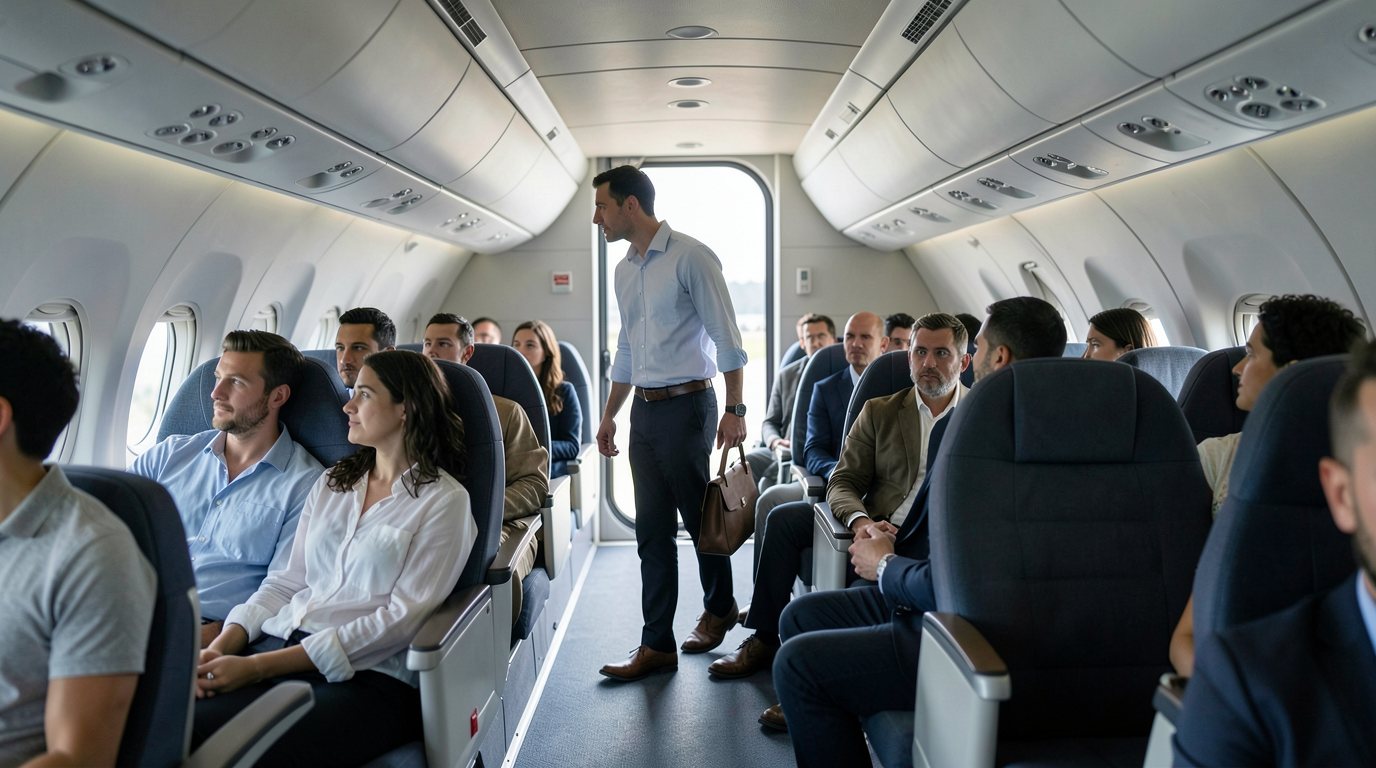
The cabin crew asked twice, then a third time. Somewhere over the Balkans a passenger who had been drinking since the departure lounge shouted at the purser, pushed the man in the next seat, and told the crew what he would do to them when the aircraft landed. The captain radioed ahead. When the doors opened at Istanbul Airport, two police officers boarded before anyone else moved, and the passenger left the aircraft between them. What follows is not decided by the airline's policy or by what the other passengers think happened; it is decided by the Turkish Penal Code and by the Civil Aviation Law, and it can range from an administrative fine paid on the spot to a criminal investigation that keeps the traveller in Türkiye for weeks.
This guide sets out the rules in the order in which they apply: whose law governs conduct in the air, what the captain is authorised to do, what the conduct becomes when the police write it up on the ground, why alcohol makes things worse rather than better, and what a foreign traveller should do in the first hours after being handed over at the gate.
1. Whose Law Applies in the Air: TCK Article 8
The first question in every in-flight case is jurisdiction, and the Turkish Penal Code answers it in Article 8. Turkish law applies to offences committed in Türkiye, and an offence is deemed committed in Türkiye where the act was wholly or partly performed there or where its result occurred there. Article 8(2) then lists the places that count: Turkish land and air space and Turkish territorial waters; and Turkish sea and air vehicles, or offences committed by means of them, on the high seas and in the airspace above the high seas. Two consequences follow for a passenger on a flight to Istanbul.
First, anything that happens once the aircraft is inside Turkish airspace is an offence committed in Türkiye, whoever operates the aircraft and wherever the passenger is from. A scuffle in the final descent into Istanbul is a Turkish assault case. Second, on a Turkish-registered aircraft the same is true over the high seas, so that a Turkish carrier's flight from New York, London or Dubai is Turkish territory for the whole of its route over open water. Where a foreign carrier's aircraft is over another State's territory when the incident occurs, the position is governed by the international rules on offences aboard aircraft, under which the State of landing has powers to deal with the passenger delivered to it; in practice the Istanbul police deal with what is reported to them at the gate, and the question of which State ultimately prosecutes is argued later, if at all.
The practical point is simple: a passenger cannot assume that conduct on a flight to Istanbul will be treated as the airline's private matter, or as belonging to the country of departure. It is written up under Turkish law, by Turkish police, at Istanbul Airport.
2. What the Captain Is Allowed to Do: Law No. 2920 Articles 101 and 102
The Turkish Civil Aviation Law, Law No. 2920, gives the commander of the aircraft two sets of powers, and both are exercised before any police officer is involved. Article 101 provides that the pilot-in-command is authorised to take the measures needed to maintain safety and order on board, to give orders and instructions to passengers, crew and any other person on the aircraft for that purpose, and, where necessary, to remove them from the aircraft. A crew member's instruction to sit down, to stop drinking or to put a device away is therefore an instruction backed by statute, and refusing it is the beginning of the record that the captain will later hand over.
Article 102, as amended in 2008, goes further. The pilot-in-command is obliged to collect and preserve the evidence of offences and misdemeanours committed on board, and is authorised, personally or with the crew, to take the necessary measures where life or property is threatened or where delay would cause harm; to keep persons under restraint until the police take charge of the matter; to search persons and their belongings; and to retain items used or attempted to be used in the offence, or whose possession is itself an offence or a misdemeanour. The same Article obliges the captain to refer the matter to the competent authorities as soon as possible, to notify the Turkish consulate where the aircraft is abroad, and in every case to submit a detailed report.
That report is the document a foreign passenger most underestimates. It is written by the person the law has made responsible for order on board, it is usually supported by crew statements taken on the same day, and it reaches the police before the passenger has said a word. Whatever the passenger later says about provocation, a misunderstanding or a language problem is measured against it. Since the 2024 amendment to Article 40 of the same Law, all passengers are also subject to technical and, where necessary, manual checks of their person and belongings on entering airports and aircraft, and a passenger who refuses a manual check after a technical check has failed to resolve the matter is not admitted to the airport or the aircraft; the Code of Criminal Procedure's rules on judicial searches are preserved.
3. What the Conduct Becomes on the Ground
The police officers who board at the gate do not charge a passenger with "being disruptive"; they write up the facts under the ordinary offences of the Penal Code, and which offence appears on the record depends on what was actually done.
Assault (TCK Article 86). Intentionally causing pain to another person or damaging his health or perception carries one year six months to three years' imprisonment. Where the effect on the victim is slight enough to be remedied by simple medical treatment, the offence is prosecuted on the victim's complaint and carries six months to one year six months' imprisonment or a judicial fine (Article 86(2)); where the victim is a woman the minimum is nine months. A push in the aisle that leaves no lasting injury is the second kind; the person pushed can complain and can also withdraw the complaint, and the reconciliation procedure of the Code of Criminal Procedure applies to that form of the offence.
Threat (TCK Article 106). Threatening a person with an attack on the life, physical or sexual integrity of himself or a relative carries six months to two years; a threat of serious harm to property or of some other wrong carries two months to six months or a judicial fine and requires a complaint. A threat made with a weapon or by more than one person together is aggravated (Article 106(2)).
Insult (TCK Article 125). Attributing to someone a concrete act or fact capable of offending honour, dignity and respectability, or swearing at him, carries three months to two years or a judicial fine; committed in public the sentence is increased by one sixth (Article 125(4)). Cabin crew are not public officials, so an insult to the purser is the basic offence; an insult to a police officer at the gate because of his duty is the aggravated form under Article 125(3)(a), with a minimum of one year.
Resisting an officer (TCK Article 265). Using force or threats against a public official to prevent him from performing his duty carries six months to three years. It is the charge that is added when the passenger who was calm in the cabin loses his temper with the police at the door; the crew cannot be the victim of this offence, the officers can.
Preventing the aircraft from moving (TCK Article 223). This is the charge that changes the scale of the case. Article 223, rewritten by Law No. 7571 of 24 December 2025, provides in its third paragraph that a person who by unlawful conduct prevents an air transport vehicle from moving is punished with five to ten years' imprisonment, and a person who takes the aircraft to a place other than its destination with seven to twelve years. Where another offence is committed in order to commit, or in the course of committing, the offence, that other offence is punished separately (Article 223(4)). Conduct that forces the captain to abort a departure, return to the gate or divert, and conduct that physically stops the aircraft from taxiing, is what the paragraph describes. It is not the ordinary drunk-and-disorderly case, and a traveller whose record mentions it needs a lawyer before he says anything.
Misdemeanours (Law No. 5326 Articles 35 and 36). Where nothing in the Penal Code fits, the police may impose an administrative fine for drunken behaviour that disturbs the peace of others, and the person may be kept under control until the effect of the drink has passed (Article 35), or for noise that disturbs the peace of others (Article 36). The amounts are revalued each year and are not the point; the point is that a misdemeanour is not a criminal conviction, does not go on a criminal record, and is the outcome the police reach for when the crew report is thin and no one was hurt.

4. Alcohol Is Not a Defence: TCK Article 34
Most in-flight cases involve drink, and most passengers assume it helps them. It does the opposite. Article 34 of the Penal Code excludes punishment only for a person who, because of a temporary cause or because of alcohol or drugs taken involuntarily, could not understand the legal meaning and consequences of the act or whose ability to control his behaviour was substantially reduced. Article 34(2) then states that this does not apply to a person who commits an offence under the influence of alcohol or drugs taken voluntarily. A passenger who drank in the lounge and on board is in the second category: the intoxication explains nothing in law, and the court will treat him as if sober. What drink does affect is the crew report, which will describe it, and the police record, which will note it; both make the assault, threat or insult easier to prove and harder to explain.
The same is true of the common explanation that the passenger "does not remember". A lack of memory is not a defence to any of the offences above, and a statement built on it reads to a prosecutor as an admission that the passenger was too drunk to know what he did.
5. At the Gate: Arrest, Custody and the Rights That Attach
The police who board the aircraft have the captain's report and the crew's account, and they will usually take the passenger to the airport police station rather than deal with the matter at the door. From that moment the ordinary rules of the Code of Criminal Procedure apply. Under CMK Article 90 a person caught in the act may be apprehended, and the person apprehended is told of the reason and of his rights; under CMK Article 91 police custody may not exceed twenty-four hours from the moment of apprehension, excluding the time necessarily spent in transfer to the judge, and the person is either released or brought before a judge within that period.
Before any statement is taken, CMK Article 147 requires that the person's identity be established, that the charge be explained, that he be told of his right to choose a lawyer and to have the lawyer present, and to have one appointed by the bar association if he cannot afford one, that a relative be informed of the apprehension, that he be told that he has the legal right not to make a statement, and that he be reminded that he may ask for evidence to be gathered in his favour. A foreign passenger who does not speak Turkish is entitled to an interpreter appointed by the prosecutor or judge for the statement. The statement is recorded and the record is signed; a refusal to sign is noted with its reasons.
Whether the case ends at the police station with a complaint-based charge that is later withdrawn or reconciled, or continues with an indictment, depends on what was written in the first hours. For the ordinary case, where no one was seriously hurt and the aircraft was not stopped, the prosecutor's file consists of the captain's report, the crew statements, the police record and the passenger's own statement; the last of these is the only one the passenger controls.
6. The Airline and the Rest of the Journey
Separately from the criminal case, the airline will act under its own conditions of carriage: the passenger may be refused onward carriage, placed on the carrier's internal list, and asked to bear the costs of any diversion. Those are contractual matters between the passenger and the carrier and are not decided by the police or the prosecutor; a diversion caused by the passenger's conduct can, however, become a civil claim by the airline for the costs it incurred, pursued separately from the criminal file. A passenger released after a statement is free to continue travelling unless the prosecutor or judge has imposed a measure preventing it; where the charge is serious enough for judicial control to be ordered, an exit ban is one of the obligations that may be attached under CMK Article 109, and the traveller should assume nothing about his flight home until his lawyer has confirmed the position.
7. What to Do in the First Hours
On board. Comply with the crew's instructions the moment they are given; Article 101 of Law No. 2920 makes them binding, and refusal is the first line of the captain's report. Do not argue with the captain's decision to restrain, search or remove you under Article 102; those powers are statutory and resisting them adds to the record.
At the door. Do not resist or insult the officers who board. The crew cannot be victims of resisting an officer; the police can, and an insult to a police officer because of his duty is aggravated under TCK 125(3)(a). Go with them.
At the station. Ask for a lawyer and an interpreter before making any statement, and say nothing about the incident until both are present; CMK 147 gives you both rights and the right to silence, and the record will show whether they were offered. Do not try to explain the drink, the stress or the lack of memory; none of it is a defence under TCK 34 and all of it is evidence. Ask your lawyer whether the charge on the record is the basic assault, threat or insult, which are complaint-based and may be withdrawn or reconciled, or whether TCK 223 has been written down, which changes everything and requires a defence prepared before any statement.
Afterwards. Keep the police record and any release document; ask whether a complaint was filed by a crew member or passenger and whether it has been withdrawn; and do not leave Türkiye without confirming that no exit ban has been imposed.
| Conduct on board | Likely charge on the ground | Provision | Complaint-based? |
|---|---|---|---|
| Pushing, slapping, grabbing another passenger or a crew member, slight injury | Simple assault | TCK 86(2) | Yes, and reconciliation available |
| Injury needing more than simple medical treatment | Assault | TCK 86(1) | No |
| "I will find you when we land", threats of violence | Threat | TCK 106(1) first sentence | No |
| Swearing at crew or passengers | Insult, public | TCK 125(1), (4) | Yes |
| Swearing at or fighting the police at the gate | Insult of an official; resisting an officer | TCK 125(3)(a); 265 | No |
| Forcing a return to the gate, blocking taxiing, causing a diversion | Preventing an aircraft from moving | TCK 223(3) as amended December 2025 | No |
| Drunk and loud, no one hurt, no instruction refused | Misdemeanour, administrative fine | Law 5326 Arts. 35-36 | Not a criminal case |
Frequently asked questions
The flight was operated by a foreign airline. Can Turkish police still arrest me?
Yes. Under TCK Article 8 an offence committed in Turkish airspace is committed in Türkiye whatever the aircraft's registration, and an offence on a Turkish aircraft over the high seas is also Turkish. For a foreign aircraft over another State's territory the international rules on offences aboard aircraft give the State of landing powers over a passenger delivered by the captain; in every case the Istanbul police deal with what the captain reports at the gate.
Can the crew really restrain or search me?
Yes. Article 102 of Law No. 2920 authorises the pilot-in-command, personally or with the crew, to keep persons under restraint until the police take charge, to search persons and their belongings, and to retain items used in the offence, and Article 101 authorises the captain to give binding orders and to remove a person from the aircraft. Resisting those measures is recorded and adds to the case.
I was drunk and I do not remember. Does that help?
No. TCK Article 34(2) provides that the exclusion of punishment for intoxication does not apply to a person who commits an offence under the influence of alcohol or drugs taken voluntarily. Drink and lack of memory are treated as evidence of the state you were in, not as a defence.
Is this a criminal record or just a fine?
It depends on what was done. Drunken or noisy behaviour that disturbs others, with no assault, threat or refusal of instructions, may be dealt with as a misdemeanour under Law No. 5326 Articles 35 and 36 by an administrative fine, which is not a criminal conviction. Assault, threat, insult, resisting the police and preventing the aircraft from moving are Penal Code offences and are investigated as such.
What is the most serious charge I could face?
Preventing an aircraft from moving under TCK Article 223(3), as amended on 24 December 2025: five to ten years for unlawfully preventing the aircraft from moving, seven to twelve years for taking it elsewhere, with any other offence committed in the course of it punished separately. It applies to conduct that stops the aircraft, forces a return to the gate or causes a diversion, not to an ordinary disturbance in the cabin.
How long can the airport police keep me?
Police custody may not exceed twenty-four hours from the moment of apprehension under CMK Article 91, excluding the time necessarily spent in transfer to the judge; within that period you are released or brought before a judge. Before any statement you must be told of your right to a lawyer, to an interpreter, to have a relative informed and to remain silent (CMK 147).
Will I be allowed to fly home?
If you are released after a statement without any measure, yes. If the prosecutor or judge has placed you under judicial control, an exit ban is one of the obligations that may be attached under CMK Article 109, and you may not leave until it is lifted. Confirm the position with your lawyer before booking anything.
Can the other passenger or the crew member withdraw the complaint?
For the complaint-based offences, simple assault under TCK 86(2), the lesser threat under 106(1) and insult under 125, a withdrawal by the complainant ends the case, and the reconciliation procedure of the Code of Criminal Procedure applies to the offences it covers. The aggravated forms, resisting an officer and TCK 223 are prosecuted without a complaint and cannot be ended by withdrawal.




This page is general information about Turkish law and procedure — not legal advice, and reading it does not create an attorney–client relationship. Laws and practice change and every case turns on its own facts, so please do not rely on it for your situation; speak with a lawyer first.
Speak with a lawyer
One call or message is all it takes. We answer 24 hours a day, every day of the year — for IST and Sabiha Gökçen.