Old Coins, Clay Lamps and Bazaar Antiques in Your Luggage at Istanbul Airport: What Law No. 2863 Says and What Happens Next (Arts. 3, 23, 24, 32, 67, 68, 75; TCK 35)
A tourist leaving Istanbul with an old coin, a clay oil lamp, a mosaic fragment or an antique bought in a bazaar is stopped at departure screening. What counts as cultural property under Law No. 2863 (Articles 3 and 23), why protected movable cultural property may not leave Türkiye (Article 32), the offence of taking it abroad (Article 68) and the rules on attempt (TCK 35), the related offences of Article 67, what happens to the item (Article 75) and to the traveller, and a checklist before you fly.
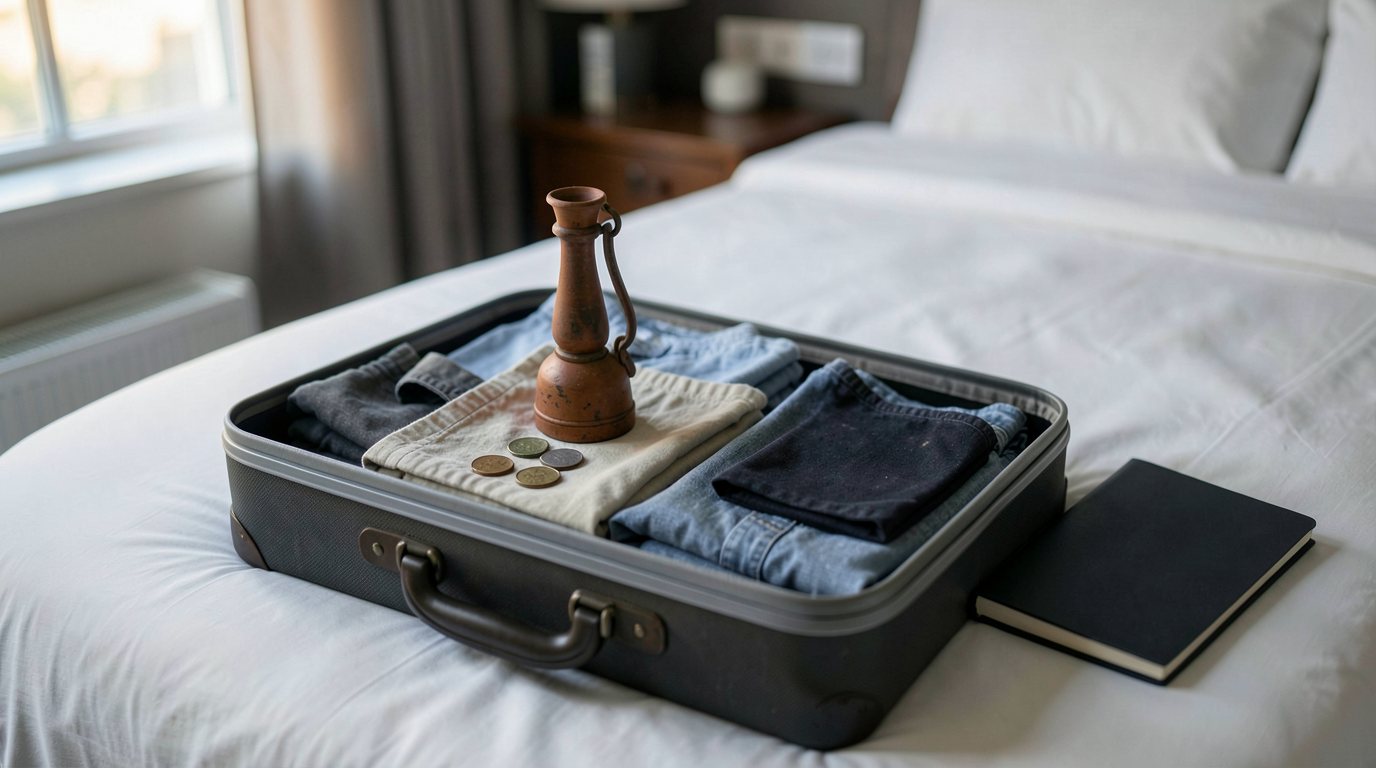
The holiday was ordinary until the last morning. A traveller who had spent a week in Istanbul packed a few things bought along the way: a handful of worn bronze coins from a stall near a covered bazaar, a small clay oil lamp that the seller said came from a village in Anatolia, perhaps a fragment of coloured stone that looked as if it had once been part of a mosaic floor. At departure screening the bag went through the X-ray, was pulled aside and opened, and the objects were laid out on a table. From that moment the question is no longer what the traveller paid for them or what the seller promised. It is what Turkish law says about taking old objects out of the country, and that law is strict.
This guide explains, in the order in which it matters to a traveller, what counts as cultural property under the Turkish Law on the Protection of Cultural and Natural Property (Law No. 2863), what does not, why protected objects may not leave Türkiye, which offence the conduct may amount to and how the rules on attempt fit in, what happens to the object and to the traveller at the airport, and what to do before flying so that none of this happens.
1. What Counts as Cultural Property: Law No. 2863 Articles 3 and 23
The starting point is the definition. Article 3(a)(1) of Law No. 2863 defines cultural property as all movable and immovable property, above ground, underground or under water, that belongs to prehistoric or historic periods and relates to science, culture, religion or the fine arts, or that was the subject of social life in prehistoric or historic periods and has original scientific and cultural value. The definition is deliberately broad. It does not depend on the object being rare, beautiful or expensive; it depends on its age and on what it can tell us about the period it comes from.
Article 23 then lists the movable cultural and natural property that must be protected. Paragraph (a) covers property of geological, prehistoric and historic periods that has documentary value in geology, anthropology, prehistory, archaeology and art history and reflects the social, cultural, technical and scientific features of its period. The list that follows reads like the inventory of a tourist's suitcase: tools of bone or metal, tiles and ceramics and similar vessels, statues and figurines, tablets, weapons, icons, glassware, ornaments, ring stones, earrings, pins, seals, bracelets, masks, diadems, written or illustrated documents on leather, cloth, papyrus, parchment or metal, weighing instruments, coins, stamped or inscribed plaques, manuscripts and illuminated books, miniatures, engravings and paintings of artistic value, relics, orders and medals, and movable objects of tile, earth, glass, wood, cloth and similar materials and their pieces. The same paragraph adds cultural property of an ethnographic character that reflects the social life of the people, including man-made tools and implements relating to science, religion and the mechanical arts.
Three consequences follow for the traveller.
First, coins are named expressly. A worn bronze coin from the Roman or Byzantine period is, on the words of the Law, movable cultural property to be protected. Its low price in a market says nothing about its legal status.
Second, fragments count. The Law protects objects "and their pieces". A shard of a clay lamp, a broken figurine or a few tesserae of a mosaic are not outside the Law because they are incomplete.
Third, there is one specific allowance for coins, and it is limited to Türkiye. Article 23(a) provides that coins of the Ottoman Sultans Abdülmecit, Abdülaziz, Murat V, Abdülhamit II, Mehmet V Reşat and Vahidettin, and coins of the same era, may be bought and sold within the country without being subject to registration under the Law; coins not covered by that sentence remain subject to the Law's general provisions. The wording is precise: the allowance is for buying and selling within the country. It does not say that such coins may be taken abroad, and a traveller should not read it as if it did.
What is not cultural property
A modern object is not cultural property simply because it looks old. A copper pot made last year, a ceramic plate painted in a traditional pattern for the souvenir trade, or a resin copy of a museum figurine does not belong to a prehistoric or historic period and does not fall within Article 3. The practical difficulty is that at departure screening nobody can tell a good replica from an original by looking at an X-ray image, and the object will be examined before anyone accepts that it is modern. That is why the paperwork the traveller carries matters: a receipt from the shop that describes the object and states that it is a modern product or a replica is the simplest evidence of what it is. It does not bind the authorities, who will rely on an expert's examination if there is doubt, but a traveller who has it is in a very different position from one who has only the memory of a conversation in a market.
2. The Export Ban and the Control of Items Leaving Türkiye: Articles 24 and 32
The central rule is in Article 32(1) of Law No. 2863: movable cultural and natural property that must be protected within the country may not be taken abroad. The only general exception in that paragraph is a temporary exhibition abroad, which requires guarantees from the authorities of the receiving country and insurance, and is decided by the President. The second paragraph allows members of the diplomatic corps in Türkiye to take out, on departure, foreign-origin cultural property that they declared when they brought it in. There is no exception for tourists, for souvenirs, for small or inexpensive items, or for objects bought openly in a shop.
Not every old object is in the same position, however. Article 24(2) of Law No. 2863 makes the buying, selling and transfer within Türkiye of ethnographic cultural property referred to in Article 23(a) free, with the periods and other features of such items and their registration conditions to be set by regulation. For items of this kind, Article 24 then provides a control mechanism for export. Under its fourth paragraph, the control of such items that are to be taken abroad in any way may be carried out by museums attached to the Ministry, or by specialist staff stationed at certain customs exit gates, the gates being designated by regulation. Under the fifth paragraph, items whose export is found objectionable after that control are identified and returned to their owners on condition that they are used within Türkiye. The State's right of pre-emption over freely tradable items is reserved.
The practical message is that an older object that a traveller believes may be legitimately exportable, such as a household item of an ethnographic character, should be examined by a museum attached to the Ministry before the traveller reaches the airport. The examination exists for exactly this purpose. An object that the museum finds objectionable is not confiscated under that paragraph; it goes back to its owner to be kept in Türkiye. Arriving at departure screening with the object in a suitcase and no examination is the route that leads to the criminal provisions below.
3. The Offence: Law No. 2863 Article 68 and Attempt Under TCK 35
Law No. 2863 deals with the offence in Article 68, headed as the provision on those who act contrary to the prohibition on taking property abroad. It provides that a person who takes cultural and natural property abroad contrary to the Law is punished with five to twelve years' imprisonment and a judicial fine of up to five thousand days. It is a serious offence by any measure, and it is the provision that an investigation at the airport will consider first.
The obvious question for a traveller stopped at departure screening is whether anything has been "taken abroad" at all. The object never left the airport. Here the general rule on attempt in the Turkish Penal Code comes in. Under TCK Article 35(1), a person who, with suitable acts, directly begins to carry out an offence he intends to commit but cannot complete it for reasons beyond his control is liable for an attempt. Under Article 35(2), outside the cases of life sentences, the penalty for an attempt is reduced by one quarter to three quarters, according to the gravity of the harm or danger caused.
Whether a stop before boarding is treated as a completed offence or as an attempt, and indeed whether the conduct amounts to an offence at all, is not something this article can answer for any particular case. It depends on the facts: where in the airport the traveller was stopped, what the object is, what the expert examination finds, what the traveller knew about the object, and how the prosecutor and, if the matter goes further, the court assess all of it. Attempt, by its own definition, requires an offence that the person intended to commit, so the traveller's knowledge and intention are part of the assessment, and they are established from evidence, not from what the traveller asserts afterwards. No one can responsibly predict the outcome from a description of the suitcase, and a traveller should be wary of anyone who does.
4. Related Offences: Law No. 2863 Article 67
Taking property abroad is not the only offence that can arise from a bazaar purchase. Article 67 of Law No. 2863 contains three further offences that are relevant to anyone who buys old objects in Türkiye.
Failure to notify. Under its first paragraph, a person who, without excuse and knowingly, acts contrary to the duty of notification relating to cultural and natural property is punished with six months to three years' imprisonment.
Buying or selling unnotified property. Under its second paragraph, a person who offers for sale, sells, gives, buys or accepts cultural and natural property that has not been notified is punished with two to five years' imprisonment and a judicial fine of up to five thousand days; in that case there is no separate punishment for the first-paragraph offence. This is the provision that makes the classic scenario so risky: a coin or a lamp offered quietly by someone who says it was found in a field may well be property that was never notified, and the Law reaches the buyer as well as the seller.
Unlicensed trade. Under its third paragraph, a person who trades without permission in movable cultural property whose trade is not prohibited is punished with six months to three years' imprisonment. The provision tells the traveller something useful: trade in old movable cultural property is a regulated activity that requires permission. A shop's lawful trade within Türkiye, however, is a different question from whether a particular object may leave the country, which is governed by Articles 24 and 32.
5. At the Airport: The Object, the Statement and the Traveller
When an object is found at departure screening and there is a suspicion that it is cultural property, the object is seized. Article 75 of Law No. 2863 provides that movable cultural and natural property seized because of offences under the Law is handed over to a museum. A traveller should therefore not expect the object to be handed back at the airport, and should not assume that it will be returned at the end of the matter.
The traveller will be asked to give a statement (ifade). The ordinary rules of the Code of Criminal Procedure apply. Under CMK Article 147, before the statement the person's identity is established, the accusation is explained, and the person is told of the right to choose a lawyer and to have the lawyer present, and to have one appointed by the bar association if he cannot appoint one himself; that a relative may be informed; that he has the legal right not to make a statement about the accusation; and that he may ask for evidence to be collected in his favour. A person who does not speak Turkish well enough to express himself is entitled to an interpreter under CMK Article 202, appointed by the prosecutor or judge during the investigation.
Three practical points follow.
Do not explain the object before you have a lawyer. A traveller's instinct is to say where it was bought, what the seller said and how little it cost. Each of those facts may matter, in either direction, and each will be written into the record. The right to remain silent exists precisely so that the statement is given once, with advice, and in a form the traveller can stand behind.
Insist on an interpreter. A statement about the age and origin of an object, taken in a language the traveller does not fully understand, is a poor foundation for any defence. The interpreter is a right, not a courtesy.
Keep every document. The receipt from the shop, any certificate the seller provided, photographs of the shop and of the object, and messages with the seller are the traveller's evidence of what he believed he was buying. They should be preserved and handed to the lawyer.
What happens next is decided by the prosecutor on the facts of the case. The prosecutor may decide to release the traveller, or may apply to a judge for measures. Where judicial control is ordered, an exit ban is one of the obligations that may be imposed under CMK Article 109, and a traveller in that position may not leave Türkiye until it is lifted. A traveller should not rebook a flight until his lawyer has confirmed the position.
6. Item by Item: The Rule and the Risk
| Item in the suitcase | Rule under Law No. 2863 | Risk at departure |
|---|---|---|
| Modern souvenir or replica with a shop receipt describing it as modern | Not cultural property if it does not belong to a prehistoric or historic period (Art. 3) | May be stopped and examined; the receipt is the evidence of what it is |
| Ottoman coin of the reigns named in Art. 23(a), or of the same era | May be bought and sold within Türkiye without registration; the allowance does not mention export | Treat as needing examination before travel; do not assume it may leave |
| Older coin (Greek, Roman, Byzantine and similar) | Coins are listed as movable cultural property (Art. 23(a)); protected property may not be taken abroad (Art. 32) | Seizure (Art. 75) and investigation under Art. 68, with TCK 35 considered for a stop before departure |
| Clay oil lamp, terracotta jug, figurine, seal | Ceramics, vessels, figurines and seals are listed (Art. 23(a)); export ban (Art. 32) | As above |
| Mosaic fragment or piece of a broken object | Pieces of listed objects are expressly covered (Art. 23(a)) | As above; being a fragment is not a defence |
| Older ethnographic household item | Domestic trade free (Art. 24(2)); export subject to control by a Ministry museum or specialist staff (Art. 24(4)) | Have it examined first; an item found objectionable is returned to be used within Türkiye (Art. 24(5)) |
| Object offered privately as a find from a field or a village | Unnotified cultural property; buying or accepting it is an offence (Art. 67(2)) | Exposure under Art. 67 even before any attempt to leave the country |
7. Before You Fly: A Checklist
- Before buying anything that looks old, ask the seller in writing whether it is an original or a modern piece, and do not buy an object described as a field find or offered outside a shop.
- For every souvenir that could be mistaken for an old object, keep a receipt that names the shop, describes the object and states that it is a modern product or a replica.
- If you believe an older object may lawfully leave Türkiye, take it to a museum attached to the Ministry for examination before you travel, and carry the result with you.
- Do not rely on the Ottoman coin allowance in Article 23(a) for export; it concerns buying and selling within Türkiye only.
- If any doubt remains about an object, leave it in Türkiye. No souvenir is worth the exposure described in Article 68.
- Pack souvenirs where they can be shown easily, together with their receipts, rather than hidden among clothes.
- If you are stopped, ask for a lawyer and an interpreter before giving any statement, and keep every receipt, certificate, photograph and message relating to the purchase.
Frequently asked questions
I bought it openly in a shop in a covered bazaar. Does that make it legal to take home?
Not by itself. A shop's lawful trade within Türkiye is a separate question from whether a particular object may leave the country. Article 32(1) of Law No. 2863 prohibits taking protected movable cultural and natural property abroad, and it contains no exception for items bought in a shop. If the object is genuinely old, what matters is whether it is protected cultural property and, for items whose domestic trade is free, whether it has passed the export control provided for in Article 24.
The seller told me it is a replica. Is a receipt enough?
A receipt that describes the object and states that it is modern or a replica is the most useful evidence a traveller can carry, and it should always be kept. It does not bind the authorities: if there is doubt, the object will be examined, and it is the examination, not the receipt, that establishes what the object is. A receipt from a shop is also worth far more than a verbal assurance from a stall.
Can I take an Ottoman coin out of Türkiye?
Article 23(a) of Law No. 2863 allows coins of the named Ottoman Sultans, and coins of the same era, to be bought and sold within the country without registration. The provision is limited to buying and selling within Türkiye and does not address export. A traveller who wants to take such a coin abroad should have it examined by a museum attached to the Ministry before travelling, and should not rely on the domestic allowance.
I was stopped before boarding and the coin never left Türkiye. Is that still an offence?
It may be. Article 68 of Law No. 2863 punishes taking cultural and natural property abroad contrary to the Law, and TCK Article 35 makes an attempt punishable where a person directly begins to carry out an offence he intends to commit but cannot complete it for reasons beyond his control, with the penalty reduced by one quarter to three quarters in cases other than life sentences. Whether a particular stop is treated as a completed offence, an attempt or no offence at all depends on the facts and on the prosecutor's and the court's assessment; it cannot be predicted in advance.
Will I get the object back?
If it was seized because of an offence under Law No. 2863, Article 75 provides that it is handed over to a museum. That is different from the export control under Article 24, where an item found objectionable is returned to its owner on condition that it is used within Türkiye. The difference is one of the strongest reasons to have an old object examined before going to the airport.
Do I need a lawyer for the statement, and will I be able to fly home?
You are entitled to a lawyer before and during the statement, to have a relative informed, to remain silent, and to an interpreter if you do not speak Turkish (CMK 147 and 202). Whether you can fly home depends on what the prosecutor and, where measures are requested, the judge decide; if judicial control is ordered, an exit ban is one of the obligations that may be imposed under CMK Article 109. Do not rebook a flight until your lawyer has confirmed that no such measure is in place.




This page is general information about Turkish law and procedure — not legal advice, and reading it does not create an attorney–client relationship. Laws and practice change and every case turns on its own facts, so please do not rely on it for your situation; speak with a lawyer first.
Related guides
All guides →Turkey Customs: What to Declare (Red vs Green Channel)
Turkey customs: which channel do you use at the airport, and what must you declare? A plain-English guide to the red vs green channel and declaration duty.
9 min readCustoms & CashCash Seized at Istanbul Airport Customs: Get It Back
Had cash seized at Istanbul Airport (IST) or Sabiha Gökçen customs? A plain-English guide to the declaration rules, the tutanak, and how to recover it.
7 min readCustomsGoods Seized at Istanbul Airport Customs: What to Do
Electronics, gifts, medication or goods held at Istanbul Airport customs? A plain-English guide to your rights, the process, and how to get your items back.
8 min readRelated service: Customs seizure — cash, goods & devices → · All airport legal services →
Speak with a lawyer
One message is all it takes. We answer 24 hours a day, every day of the year — for IST and Sabiha Gökçen.